
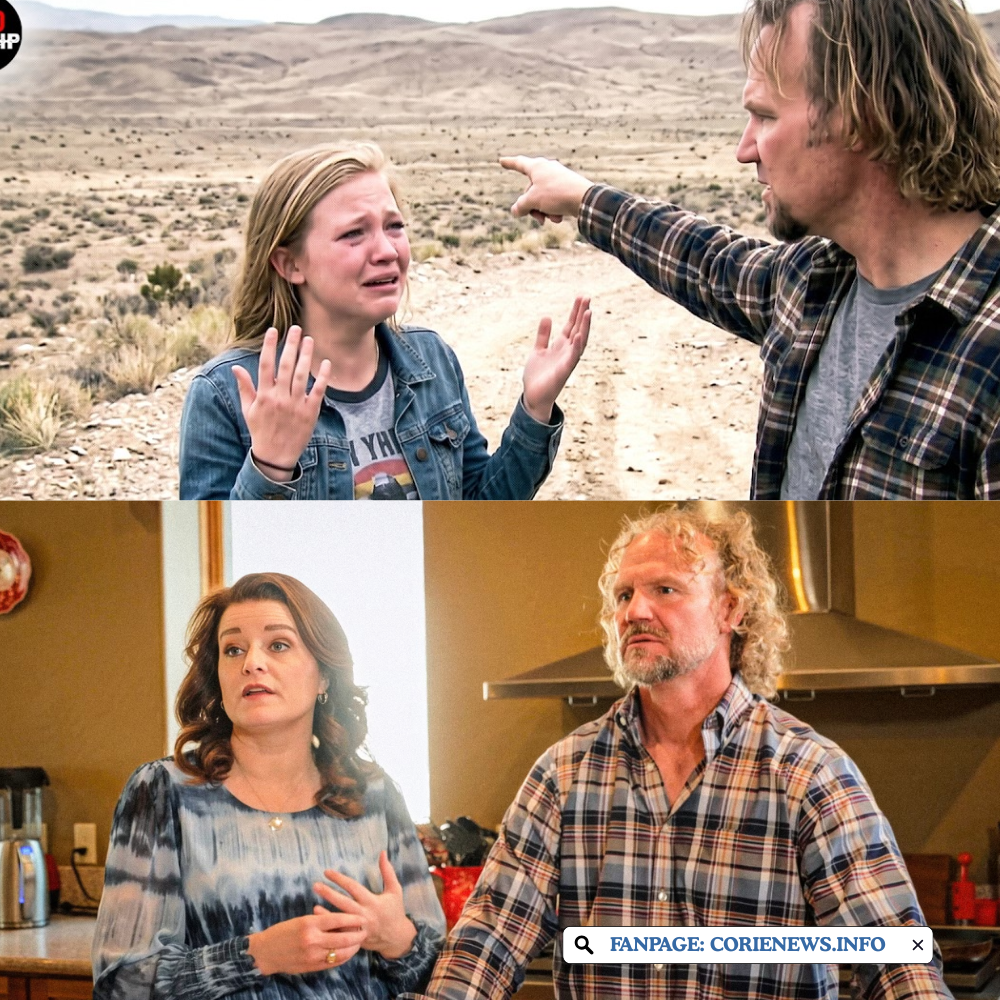
4.3 Acres. 6 Years. Zero Houses Built | What Kody Brown Did With The Sister Wives Land
4.3 Acres. 6 Years. Zero Houses Built | What Kody Brown Did With The Sister Wives Land
When Sister Wives first introduced the idea of a shared dream property in Flagstaff, Arizona, it sounded like the ultimate fulfillment of everything the Brown family had been promising viewers for years. Back in 2018, Kody Brown unveiled what he described as their “forever home” — a sprawling 4.3-acre parcel known as Coyote Pass. His vision was bold, almost cinematic: four houses, one for each wife, all built on a single piece of land, creating a unified family compound where love, cooperation, and plural marriage would finally exist in physical form.
It was the kind of dream that felt almost too perfect. After years of living apart in separate neighborhoods, separated not just by distance but by growing emotional divides, this land was supposed to fix everything. It was meant to bring unity, stability, and a renewed sense of purpose. Kody painted a picture of children running freely between homes, shared outdoor spaces filled with laughter, and a family finally living as one cohesive unit.
But fast forward six years, and that dream stands in stark contrast to reality. The land remains largely untouched. No houses. No construction. No compound. Instead, what once symbolized unity now reflects something entirely different: fragmentation, failed promises, and a family that has largely fallen apart.
To truly understand how everything unraveled, you have to go back to what the Browns had before Flagstaff — and what they gave up.
For years, the family lived in Las Vegas, Nevada. While the city itself might seem chaotic on the surface, their living situation there provided something incredibly valuable: independence. Each wife had her own home, her own neighborhood, her own space to build a life. Meri had her circle, Janelle had hers, Christine created a household that felt distinctly her own, and Robyn established her place within the family dynamic.
This separation wasn’t a weakness — it was a survival strategy. In a plural marriage, constant proximity can amplify tension. Distance, on the other hand, allows individuality to exist. It gave each woman a sense of control over her own life, something that became increasingly important as the years went on.
The children, too, thrived in Las Vegas. They built friendships, attended schools, and developed routines that grounded them. For many of them, Nevada wasn’t just a temporary stop — it was home.
So when Kody suddenly announced the move to Flagstaff, it came as a shock. The reasoning sounded reasonable enough on the surface: better quality of life, cooler weather, improved schools, a more peaceful environment. It was framed as a decision made in the best interest of the family.
But beneath that explanation, there were cracks.
The timing of the move raised questions. By that point, the show had been running for years, and the family’s life in Las Vegas had stabilized. And in reality television, stability often translates to declining ratings. A dramatic relocation, a massive land purchase, and the promise of building a one-of-a-kind plural family compound — that’s not just a life decision. That’s a storyline.
Whether intentional or not, the move injected fresh drama into the series. It created tension, uncertainty, and endless possibilities for conflict — all the ingredients needed to keep viewers engaged.
Then came Coyote Pass itself.
Kody spoke about the land with unwavering confidence. He had a clear vision of how everything would look, how the houses would be arranged, how the family would function once they were all together again. But there was one major issue: the vision didn’t seem to be shared equally.
The wives weren’t co-architects of this dream — they were being asked to adapt to it.
Christine was the first to visibly hesitate. Her concerns weren’t just about logistics; they ran deeper. In Las Vegas, her home was her own domain. In Flagstaff, her future house would be part of a larger structure controlled by Kody. The shift wasn’t just physical — it was psychological.
That subtle difference mattered more than anyone initially admitted.
While Kody interpreted her hesitation as resistance or lack of commitment, Christine was actually recognizing something fundamental: this new setup would strip away the independence she had fought to maintain.
And she wasn’t alone in that realization.
Then, just as plans were being discussed and ideas were forming, the world changed.
The COVID-19 pandemic hit in early 2020, bringing everything to a halt. But instead of uniting the family, it exposed the fractures that had been quietly growing for years.

Kody implemented strict protocols that effectively separated each household completely. No interaction. No shared time. No blending of families. What might have seemed like caution quickly revealed a deeper truth: the Browns were no longer functioning as one family.
They were four separate households connected only by Kody — and even that connection became uneven.
As restrictions tightened, Kody made a choice that didn’t go unnoticed. He spent the majority of his time with Robyn, leaving the other wives isolated. The imbalance became undeniable.
And suddenly, the idea of building four homes on one piece of land no longer felt like unity. It felt like control.
Coyote Pass began to look less like a shared dream and more like a structure where one person held all the authority.
The shift in perception was profound. The children saw it. The wives felt it. And slowly, without dramatic announcements, the belief in the project began to fade.
Plans were delayed. Conversations stalled. Deadlines came and went with no progress. Each time Kody spoke about building, it felt more like talk than action.
Meanwhile, the children — often overlooked in the broader narrative — were living the consequences.
They had been uprooted from their lives in Las Vegas, leaving behind friends, schools, and stability, all for a promise that never materialized. Instead of moving into a dream home, they found themselves scattered across rental properties in a city they hadn’t chosen.
The sacrifice was real. The reward never came.
Some of the older children, like Aspyn, had openly questioned the move from the beginning. Looking back, those concerns now seem incredibly prescient. But at the time, their voices didn’t carry enough weight to change the course of events.
As the years passed, the gap between promise and reality only widened.
And then, one by one, the family began to fall apart.
Christine eventually left. Janelle followed. Meri drifted further away. The plural marriage structure that Coyote Pass was meant to solidify instead crumbled under the weight of unmet expectations and unresolved tensions.
Through it all, the land remained untouched.
No construction. No foundation. Just empty desert.
Which brings us to the uncomfortable question many fans have been asking for years: was Coyote Pass ever truly meant to be built on?
There’s a growing theory among viewers that the purchase wasn’t just about creating a home — it was about creating a storyline. The timing, the scale, the drama surrounding the move — it all aligns almost too perfectly with what the show needed at that moment.
While there’s no definitive proof, the pattern is hard to ignore. Major life decisions within the family often coincide with major shifts in the show’s narrative.
If that theory holds even a fraction of truth, it reframes everything.
Because at the center of it all are real people, real relationships, and real consequences.
Today, Coyote Pass stands as more than just undeveloped land. It has become a symbol — a physical representation of promises made but never fulfilled. It reflects the gap between vision and reality, between intention and execution.
Kody still talks about building. He still speaks about what could be. But after six years, those words carry less weight than they once did.
Because the truth is simple, and impossible to ignore:
The land is still empty.
And the family it was meant to unite is no longer the same.