The Final Ride: Yellowstone’s Sudden Sunset
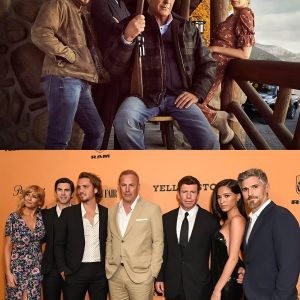
The Dutton legacy was never meant to end quietly. For five gripping seasons, Yellowstone brought the dusty roads of Montana to life with betrayal, heartbreak, and the iron grip of family loyalty. But now, as the credits roll on the flagship series, showrunner Taylor Sheridan points the finger squarely at Kevin Costner. The abrupt ending? He claims Costner’s exit derailed everything. Yet, for fans and insiders alike, the truth may run far deeper than clashing egos and shooting schedules.
Could Yellowstone have continued for years if not for Costner’s supposed demands? Maybe. But when you watch 1923—Sheridan’s prequel masterpiece—you start to question if the real reason behind Yellowstone’s fall was something even more powerful: creative closure.
Sheridan’s Blame Game: Convenient or Calculated?
Taylor Sheridan hasn’t minced words. According to multiple reports—including a bombshell from Bloomberg—Sheridan had mapped out three additional seasons of Yellowstone. But when Costner committed to his own passion project, Horizon, scheduling conflicts and behind-the-scenes negotiations spiraled out of control. Suddenly, the man who had been the face of the ranch for years was gone.
The exit wasn’t even granted an on-screen farewell worthy of John Dutton’s legend. No heartfelt goodbye, no final standoff—just a quiet absence. For fans, it felt like the show had been robbed of its emotional climax.
Costner wasn’t shy about his side of the story. In a 2023 Deadline interview, he revealed, “I made a contract for seasons five, six, and seven.” But as production split Season 5 into Parts A and B, things got murky. Negotiations fell apart. Costner walked. And the show? It started rewriting its end—fast.
But Was It Really Just About Costner?
While Costner’s departure created logistical nightmares, it’s hard to ignore the possibility that Yellowstone was already running on fumes. The drama off-screen might have just accelerated a decline that was already underway.
Enter 1923—a series that proves Sheridan hasn’t lost his storytelling edge. Visually stunning and emotionally rich, it feels less like a spin-off and more like a spiritual sequel. Starring Harrison Ford and Helen Mirren, it brings back the Dutton legacy with renewed vigor. If Yellowstone was a modern-day Greek tragedy, 1923 is the myth that birthed it.
And here’s the kicker: 1923 doesn’t feel like filler. It feels like Sheridan rediscovered his muse—just somewhere else.
Creative Burnout or Narrative Evolution?
It’s tempting to believe that Yellowstone’s story still had miles left to travel. But maybe it had simply run its course. How many times could John Dutton beat back land developers, political rivals, and his own children before it began to feel repetitive?
Sheridan, a former actor turned creative powerhouse, built the Dutton-verse from the ground up. But empires evolve. And judging by 1923’s success and the upcoming projects—including 1944, The Madison, and rumored Beth-and-Rip spin-offs—it’s clear Sheridan is steering the ship toward a new frontier.
So yes, maybe Sheridan blames Costner. But at the heart of it, Yellowstone may have ended not because it had to—but because it was time.
Cole Hauser’s Next Chapter: A Quieter Frontier
While Sheridan reshuffles his Dutton deck and Costner rides into his own Horizon, one of Yellowstone’s breakout stars is taking a much quieter path. Cole Hauser, who played the beloved Rip Wheeler, hasn’t announced a major new role—at least not yet.
Instead of signing onto the next big series, Hauser has been spotted traveling from New Zealand to Botswana, enjoying a rare pause in his career. And fans are eating it up. While other cast members like Kelly Reilly (Beth Dutton) and Luke Grimes (Kayce Dutton) explore new acting ventures, Hauser is content to breathe.
But don’t think he’s finished with Rip Wheeler just yet.
According to rumors, a Beth-and-Rip spin-off is in early development, giving fans a chance to revisit the most fiery romance in Yellowstone history. Speaking to People, Hauser teased: “America has spoken. They still love the show… Hopefully, we can continue to get into people’s living rooms and entertain them the way we have over the last seven years.”
A Legacy That Refuses to Die
If Yellowstone has taught us anything, it’s that family doesn’t end when the series does. The Dutton legacy is more than just John Dutton. It’s Beth’s fiery vengeance, Rip’s quiet strength, Kayce’s struggle between two worlds, and the deep, generational trauma that binds them all.
That’s why 1923 hits so hard. It’s not just a historical prequel—it’s a reminder that the Duttons have always been complicated, broken, and unbreakable. Sheridan may be done with Yellowstone—at least in its original form—but he’s far from finished with the family at its heart.
Will the Duttons Ride Again?
Even with Costner out of the saddle, Sheridan’s world continues to grow. 1944 is rumored to be the next chapter, possibly introducing new ancestors or descendants of the Dutton family. Michelle Pfeiffer and Kurt Russell are headlining The Madison, adding more Hollywood firepower to the Yellowstone universe.
So what’s next?
If you’re hoping for a return to the Yellowstone Ranch with the same cast, don’t hold your breath. But if you’re ready to dive deeper into the mythology, the heartbreak, and the unrelenting loyalty that define the Duttons, then the best may still be ahead.
Because in Sheridan’s world, endings are never final. They’re just the beginning of another fight, another frontier.
The Final Verdict: Who’s Really to Blame?
Costner’s departure undoubtedly reshaped Yellowstone’s final act. But putting all the blame on one man doesn’t tell the whole story. The writing had been on the barn wall for a while. The series that started with a bang couldn’t possibly end with a whimper—so it didn’t. It passed the torch.
From 1883 to 1923 and soon 1944, Sheridan has ensured that the Duttons endure—not just in our screens, but in TV history. Maybe the real story isn’t about what Costner took away. Maybe it’s about what Sheridan built next.